Will Container Prices Rise? The Signals for the Last Quarter of 2026

Higher production costs, more expensive energy, port congestion and demand that is still holding up could all put pressure on container prices as 2026 draws to a close. For Econtainers Global, managing inventory ahead of time will make the difference for buyers and operators.
The global container market is heading into the last quarter of 2026 with more volatility and with signals that could translate into upward pressure on equipment prices. The effect will not be the same in every market or for every container type, but several indicators point to a year-end in which buying equipment may cost more, especially in certain regions and for the most requested units.
Production costs are climbing
One of the main drivers is the cost of manufacturing. China still builds most of the world's containers, and the price of industrial inputs has started to rise. In the last week of August, for example, hot-rolled steel sheet in China rose 1.9% compared with the previous period.
Energy is adding to the pressure. Brent crude climbed above US$100 a barrel in September, while the availability and price of marine fuel are being affected by current geopolitical tensions. Reuters reported that fuel oil inventories in major hubs such as Singapore, Amsterdam-Rotterdam-Antwerp and Fujairah are around 30% below seasonal levels, and very-low-sulfur fuel oil prices in Singapore have risen significantly since the conflict with Iran began.
The pressure does not only come from factories
Logistics costs are also shaping the market. The Drewry World Container Index closed on September 3 at US$4,465 per 40-foot container. The index was practically flat week on week, but it still reflects an elevated freight market. Drewry currently describes the market as "balanced to tightening", with growing port congestion, higher fuel costs and deteriorating schedule reliability.
This matters because the cost of moving and repositioning a container ends up in the effective cost of that unit in the destination market. Drewry has also noted that average waiting times at ports are increasing. When a container stays longer than expected in one area, it is temporarily unavailable in other markets, and repositioning it becomes more expensive.
Resilient demand, uneven availability
Demand has not weakened across the board. Maersk raised its outlook for 2026 again, attributing part of the improvement to global container demand that has remained resilient, together with higher rates and congestion in some of the main Asian ports.
Yet the equipment market cannot be read from the size of the global fleet alone. Availability remains very uneven between regions. A recent analysis of the U.S. market points out that, while Chinese production of dry and refrigerated units stays high, available inventory and repositioning flows are shifting between markets. In other words, there can be enough manufacturing capacity worldwide and, at the same time, shortages or higher prices for some equipment in specific locations.
That gap will matter most in the fourth quarter, when buyers and operators start securing equipment for year-end needs and for their 2027 planning.
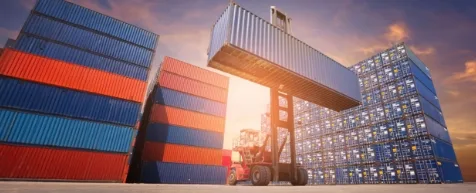 See which containers are in stock right now, with price and depot for every unit.
 What could happen to prices in Q4?
The most likely scenario is not a uniform increase for every container, but a wider spread of prices depending on equipment type, origin, destination and local availability.
New units built in Asia already carry a cost structure that is sensitive to steel and other inputs. At the same time, some manufacturers are reaching the fourth quarter with busy production schedules. Recent market data shows production heavily concentrated in 40-foot High Cube (40HC) units, while 20-foot standard (20GP) units account for a considerably smaller share of planned output.
That could create a particular situation: the world will not necessarily run short of containers, but certain types may become scarce in certain markets, and units available for immediate delivery may carry a price premium.
Strategic inventory is an advantage again
For Econtainers Global, this scenario calls for looking beyond the factory price.
"The last quarter of 2026 may bring more volatility in the cost and availability of containers. In this context, the decision is not only when to buy, but where the equipment the customer needs is available and what the real cost of putting it in their hands will be."
— Andrés Valencia, CEO of Econtainers Global
According to Valencia, the combination of production, energy, transport and repositioning costs makes the location of inventory more and more important.
"Local and regional availability can become as important as the purchase price. Holding strategic inventory reduces exposure to sudden market moves and lets us respond faster to what customers need."
A year-end that calls for planning ahead
The last quarter traditionally concentrates buying, repositioning and planning decisions for the following year. In 2026, those decisions are also shaped by a changing geopolitical environment, higher energy costs, port congestion and significant differences between markets.
For container buyers, waiting until the need is urgent could mean paying more or having fewer options. The conclusion for the industry is clear: in an increasingly volatile market, availability has a price too. Anticipating needs, monitoring origin and destination markets and keeping inventory in the right places will be key to controlling costs at the close of 2026 and preparing operations for 2027.
Planning your year-end purchase? Browse dry containers and reefer containers, or talk to our team about availability near you.
Related reading: The new geography of maritime trade and why immediate container availability matters.
This article was first published in Spanish by Mundo Marítimo on September 14, 2026.