The New Geography of Maritime Trade: How Conflicts Are Reshaping Global Routes

Tensions in the Middle East, uncertainty in the Strait of Hormuz and changes in Red Sea transits are forcing carriers and logistics operators to rethink their routes. At the same time, new alternatives such as the Arctic sea route are gaining attention. For Econtainers Global, this shift is also changing how containers are distributed, circulated and repositioned around the world.
The map of maritime trade is changing
For decades, corridors such as the Suez Canal, the Strait of Hormuz, Bab el-Mandeb and the Panama Canal have connected the world's main production and consumption centers. Today, geopolitical conflicts, threats to maritime security and climate conditions are pushing carriers to reconsider routes that until recently seemed fixed.
The result is an industry working under an increasingly clear premise: sea routes are no longer defined only by distance and efficiency, but also by security, resilience and the ability to adapt.
Suez is regaining ground, but the risk remains
One of the most important changes of recent weeks is happening around the Suez Canal. After more than two years of disruption linked to security in the Red Sea, some of the largest carriers have started to increase their operations through this route again.
In July, Maersk and Hapag-Lloyd resumed certain services through the Red Sea and the Suez Canal within their Gemini network, after a long period sailing around the Cape of Good Hope. MSC has also recently increased its transits in the area, with seven of its vessels passing through Bab el-Mandeb in a two-week span.
The recovery is far from a full return to normal. According to Lloyd's List Intelligence, around 1,090 transits were recorded at the northern end of the Red Sea in the four weeks before August 19, the highest level since early 2024, but still 41% below pre-crisis levels. Maritime authorities also keep risk levels high because of new incidents in the area, so carriers are returning selectively and constantly reassessing security conditions.
Hormuz: a new pressure point for world trade
If Suez is showing signs of recovery, the Strait of Hormuz is one of the main sources of uncertainty. The conflict between the United States and Iran has sharply reduced traffic through this strategic corridor. Before the conflict, roughly one fifth of the world's oil and liquefied natural gas shipments passed through it.
Political signals remain contradictory: while the United States maintains that the strait is open, Iran maintains that it is closed to shipping. That uncertainty is leading many shipowners to avoid the area. It is also changing the decisions of large Asian operators: two Chinese state-owned shipping companies have stopped sending tankers through Hormuz and Bab el-Mandeb and have looked for alternatives to keep energy supply flowing.
Although most of the direct impact falls on energy transport, the consequences reach the entire logistics chain through higher costs, insurance premiums, transit times and the need to use alternative routes.
The Red Sea is still a risk zone
The partial recovery of Suez traffic does not mean the Red Sea has stopped being a risk zone. On August 20, a tanker was reported hijacked in the Gulf of Aden: six armed individuals boarded the vessel and diverted it toward Somalia, only days after another piracy-related attack in the region.
These events add a new variable. Carriers must weigh not only conflict between states and attacks by armed groups, but also piracy and other security incidents. Even when services return to the Red Sea, the decision to use Suez still depends on risk assessments that can change quickly.
What does all this mean for containers?
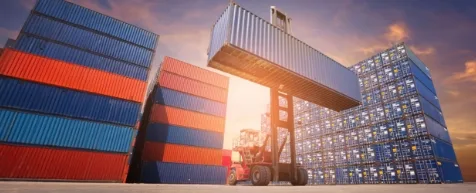
Route changes do not only affect ships. They also transform how containers circulate around the world.
- Longer routes tie up equipment. When an Asia-Europe service stops using Suez and sails around the Cape of Good Hope, the voyage gets longer. Containers stay inside the logistics chain for more time and take longer to return to the markets where they will be used again.
- Every route change resets the cycle. When a carrier switches back to Suez, container turnaround changes once more, and empty equipment accumulates in some places while it runs short in others.
- Location becomes as important as price. A container may physically exist somewhere in the world, but that does not mean it is available for a specific operation at the moment it is needed.
"Containers follow the flows of world trade. When routes change, the location of the equipment and the time it spends inside the logistics system change too. That is why a geopolitical crisis can end up creating imbalances in container availability between regions."
— Andrés Valencia, CEO of Econtainers Global
 Need equipment where you are? Check live container inventory by location.
 The new priority: flexibility
Recent market developments are leading companies to look for more flexible supply chains. Having alternative suppliers, access to different markets and visibility over equipment availability makes it possible to react faster when a route is restricted or trade flows change.
"Responsiveness has become strategic. Companies need to adapt quickly to changes in routes, demand and equipment availability. Having presence and inventory in different markets makes it possible to find alternatives when conditions change."
— Andrés Valencia
New alternatives on the maritime map
The transformation of routes is also driving the search for new corridors. One of the most recent examples is the Northern Sea Route in the Arctic. South Korea announced the first trial voyage of a South Korean container ship to Europe on this route, scheduled for August 22: the PanStar Akro, of about 2,800 TEU, sailing from Busan to Rotterdam through the Bering Strait and the Arctic Ocean.
The route could cut the distance by roughly 30% compared with the traditional Suez route and save more than ten days of sailing under certain conditions. Major challenges remain, however, in navigation conditions, infrastructure, safety and service availability. For now it is an experimental operation, but it reflects a broader trend: world trade is looking for alternatives to its growing exposure to risks concentrated in a few strategic corridors.
Panama is under pressure too
The change is not limited to the Middle East. The Panama Canal announced that it would reduce the number of daily transits from September because of lower water reserves linked to El Niño. The canal authority initially expects a limit of 34 vessels a day, which could later drop to 32. This adds pressure to a maritime network that already faces several points of vulnerability, and it means that a disruption in one region can have effects in others, because ships and containers must be redistributed to keep goods moving.
An industry that has to learn to move
The events of 2026 show that maritime trade is entering a stage in which efficiency can no longer be measured only in miles or days at sea. Security, infrastructure, climate, geopolitics and the ability to find alternative routes are now part of the equation. For the container market, this means a greater need for visibility, strategic inventory and repositioning capacity.
"We are facing a much more dynamic market. The question is no longer only which route is shortest, but which is the safest, most reliable and most sustainable way to keep operating. The same logic applies to containers: having access to the right equipment, in the right place and at the right time will matter more and more."
— Andrés Valencia
As carriers look for new ways to keep the world connected, the container market will have to keep pace, adapting to trade flows that are less and less predictable, in a global supply chain where flexibility has stopped being an advantage and become a necessity.
Related reading: Will container prices rise in the last quarter of 2026? and The new map of global trade and the strategic role of containers.
This article was first published in Spanish by Mundo Marítimo on August 31, 2026.