Optimization and Efficiency: Keys to an Effective Cold Chain

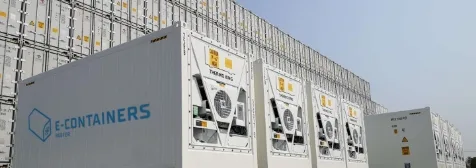
Handling and transporting certain products requires controlled humidity and temperature, which is why refrigerated containers for the cold chain are essential. With the right strategies, you can also build a sound supply chain, control the variables during transport and act at the right moment. Here is everything you need to know.
Fundamental strategies to improve cold chain management
According to the International Institute of Refrigeration, roughly 1.6 billion tons of products are wasted because of poor decisions in cold chain management.
With that in mind, here are 5 strategies that will help you gain more control over the conditions in which your products travel, guarantee their preservation and react quickly to any incident.
1. Temperature control and measurement
Temperature and humidity are recorded and controlled using the right materials and tools. Within the cold chain, this is without doubt one of the most important activities.
2. Storage conditions
During storage, three essential characteristics must be met: hygiene, refrigeration and effective logistics.
The most important activities in storage are:
- Placement of the products and the equipment.
- The different types of packaging.
- Storage temperatures.
- Loading and unloading the products (which must be done with great care).
- Picking, also known as order separation.
Today, refrigerated warehouses no longer collect temperature readings by hand: sensor-based monitoring delivers the data ready for analysis.
There are other types of monitoring too, such as computational fluid dynamics and thermal imaging. Both analyze airflow during the cooling process and help determine the optimal ventilation for cold storage.
3. Transport and its conditioning
It is vital that vehicles meet the necessary requirements and conditions, such as:
- Removing residual heat and pre-cooling to the lowest temperature closest to that of the product to be transported.
- Having the necessary temperature control equipment.
- Having the means to deliver the temperature log of the journey at destination.
- Completing the corresponding records at origin and destination.
4. Innovation in information technology
Good software is indispensable, since it helps manage and control every logistics operation. Advanced technology brings maximum efficiency to every process, system and control and monitoring device. There are even natural refrigeration systems today that extract field heat to start the cold chain process.
Greater monitoring capacity makes it possible to take corrective action whenever a critical variable falls outside the established range.
5. Legal regulations
It is important to know that there are legal regulations the logistics operator must comply with. Any failure in the chain directly damages the products and lowers their quality, and low quality can often have consequences for human health, such as the growth of dangerous microorganisms.
As you can see, a plan for proper cold storage will always help you stay organized, simplify monitoring, produce overall reports and guarantee sound decision-making.
 Talk to a sales advisor about refrigerated containers for your cold chain.