Genset: Power for the Cold Chain in Transit
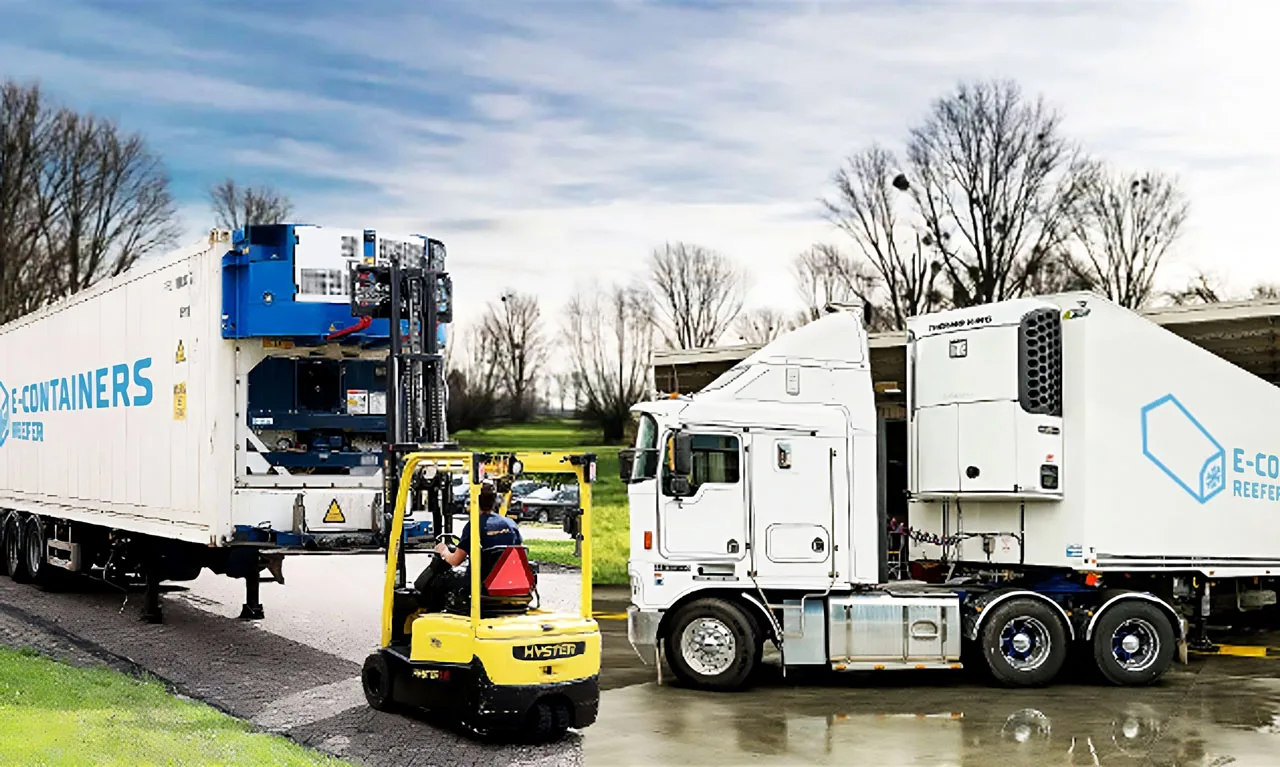
A genset is a self-contained diesel generator that supplies electricity to the refrigeration unit of a refrigerated container when it has no access to a power outlet. Its function is simple and critical: to keep the cold chain from breaking precisely on the legs where there is no plug, that is, while the container travels by road, waits in a yard with no power supply or moves between facilities.
The name comes from generator set, the engine and alternator assembly that produces the power. In the reefer world, genset refers to generators designed specifically to attach to a refrigerated container or to the chassis carrying it.
What a genset is and why it exists
A refrigerated container does not produce cold on its own. Its refrigeration unit is an electrical machine that needs continuous power to run the compressor, the evaporator fans and the controls. If the power is cut, the unit stops: for a while the container's insulation holds the temperature, but every hour without active cooling brings the cargo closer to the limit of its allowed range.
The industry standard for powering a reefer is a three-phase supply in the 380 to 460 V range, at 50 or 60 Hz, usually through a 32 A connector with three poles plus ground. In the Americas the grid runs at 60 Hz. That is the kind of power the genset must deliver, and it is why not just any generic generator will do: it has to match the voltage, frequency and connector type the refrigeration unit requires.
A reefer genset essentially consists of a diesel engine, an alternator, a fuel tank, a control panel with protections and a mounting system to fix it to the container or the chassis, all inside a housing built for weather and vibration. If you want to understand the equipment it powers, read
Types of genset
Underslung genset (under the chassis)
The underslung genset is mounted under the chassis of the tractor or the container trailer, in the space between the axles. Being integrated into the vehicle, it takes no space at the front of the container and does not change its length, and it keeps the center of gravity low, which favors stability on the road.
Its operational advantage is that it stays permanently on the chassis: there is no need to mount and dismount it every time the container changes. Its disadvantage is that it ties the generator to a specific vehicle, so it only makes sense when the fleet moves refrigerated cargo regularly.
Clip-on genset (attached to the container)
The clip-on hooks directly onto the container's corner castings, usually on the front face next to the refrigeration unit. It attaches and detaches in a few minutes with a mechanical anchoring system, which makes it very flexible.
It is the typical option when the generator is needed only for a specific leg, when the fleet is mixed or when the same generator must rotate among several containers. The trade-off is that it adds weight and overhang to the front of the container, which must be checked against the permitted dimensions of the vehicle-plus-load combination.
Yard or terminal genset
These are generator sets that do not travel with the container: they sit in the yard, the free trade zone, the farm or the project site and power one or more parked reefers while they wait for loading, inspection or shipment. They can be skid-mounted, trailer-mounted or in a soundproof enclosure, and they usually have more capacity because they serve several units at once.
This is the format used when the storage point lacks a sufficient three-phase supply, a frequent scenario in rural agricultural production areas.
| Type | Where it is mounted | When it makes sense | Point to watch |
|---|---|---|---|
| Underslung | Under the vehicle chassis | Fleets that move reefers permanently | Tied to one vehicle; workshop maintenance |
| Clip-on | On the container's front corner castings | One-off services, mixed fleets, rotating generator | Adds weight and overhang at the front; anchoring and dimensions |
| Yard or terminal | Fixed or trailer-mounted on site | Temporary storage without three-phase supply | Needs space, ventilation and fuel handling |
How much autonomy a genset gives and what it depends on
There is no single autonomy figure, and you should be wary of anyone who offers one without asking anything about the cargo. The time a genset can sustain refrigeration depends on the combination of several factors:
- Fuel tank capacity of the specific unit contracted.
- Set point temperature: keeping frozen product demands far more compressor work than keeping chilled product.
- Ambient temperature and solar radiation: a night run through the highlands is not the same as midday on a tropical port road or in a port yard.
- Container condition: sound insulation, door gaskets in good shape and clean drains reduce the heat load; a reefer with worn seals works the unit harder.
- Product heat load: if the goods go in warm or without pre-cooling, the unit runs flat out for hours.
- Door openings and defrost cycles, which force the unit to recover temperature.
- Operating mode: continuous or start-stop, as the product allows.
- Mechanical condition and maintenance of the engine and alternator.
That is why real autonomy is estimated case by case, with the specific profile of the route and the product. If you need that calculation for a specific operation, write to us with the route, the product and the target temperature.
Genset vs. electrical connection at the port and on the ship
The genset does not compete with the electrical connection: it complements it. Each power source covers a different leg of the chain.
| Source | Leg it covers | Advantages | Limitations |
|---|---|---|---|
| Fixed supply at plant or warehouse | Pre-cooling, loading, storage | Stable power, no fuel or noise | Only where an adequate three-phase installation exists |
| Port terminal reefer plugs | Yard waiting before and after the vessel | Continuous power and terminal monitoring | Subject to reefer slot availability and terminal charges |
| Vessel reefer plugs | Ocean crossing | Permanent power and control on board | Depends on the reefer allocation the shipping line assigns to the vessel |
| Genset | Road transport and sites without supply | Total independence from the connection point | Requires fuel, maintenance and autonomy control |
Where in the logistics chain each one is used
In a typical export of flowers, bananas or Hass avocados from Colombia, the sequence is usually this: the product is pre-cooled and loaded at the plant or the farm using the fixed supply; the container leaves for the port of Cartagena, Buenaventura or Santa Marta and a genset powers it for the whole road leg; on arrival at the terminal it is disconnected and plugged into a reefer slot in the yard; during the crossing the vessel's plugs power it; and at destination the scheme repeats in reverse order.
The risk points are always the transitions: the moment of disconnecting from the plant and starting the genset, and the moment of handing the container over at the port. That is where most temperature excursions happen, so it is worth documenting every change of power source with the time and the unit's reading.
What to check before contracting a genset
- Electrical compatibility: voltage, frequency and connector type must match what the container's refrigeration unit requires.
- Capacity against the starting demand: the compressor draws more power on start-up than in steady operation; the generator must handle that peak without voltage drops.
- Estimated autonomy for your specific route, with a safety margin for road delays, terminal queues or road closures.
- Refueling plan and who is responsible for carrying it out en route.
- Maintenance status and equipment log: operating hours, latest service and functional tests.
- Anchoring and dimensions: the mounting must respect the permitted dimensions of the combination and must not compromise the container's structure.
- Monitoring: how you will know the unit is still running and at what temperature, without depending on a call to the driver.
- Failure response: who responds, how fast and with what replacement equipment if the generator stops on the road.
That last point carries the most weight. A cheap genset with no operational backup ends up costing the full value of the cargo. If you want to size the generator together with the container, contact our team.
Frequently asked questions
Does a genset work with any refrigerated container?
Only if it matches the electrical requirements of the refrigeration unit: voltage, frequency and connector. Before contracting one you must confirm the data sheet of the container's unit and not assume compatibility from the size of the box.
How much fuel does a genset use?
It depends on the model, the set point, the ambient temperature and the product's heat load, so there is no standard figure that applies to every case. The estimate is made on the specific unit and the real route profile.
What is the difference between a clip-on and an underslung?
The clip-on attaches to the container and can rotate among units in a few minutes; the underslung is mounted under the vehicle chassis and stays there even when the container changes. The first gives flexibility, the second gives continuity for fleets dedicated to refrigerated cargo.
Do I need a genset if I only move the container inside the port?
For short movements within the same terminal a quick reconnection to a reefer slot is usually enough, but any trip on a public road or a prolonged wait away from a plug requires a generator. The practical rule is that no sensitive product should go without active cooling for longer than its protocol allows.
What happens if the genset fails on the road?
The container's insulation gives a limited margin before the temperature goes out of range, and that margin shrinks with ambient heat and frozen product. That is why the contract must define in advance the response time, the replacement equipment and the operational contact.
 Need a reefer that keeps its temperature on the road? See our refrigerated containers and ask about genset options.