Reefer Container: Types, Dimensions and Uses
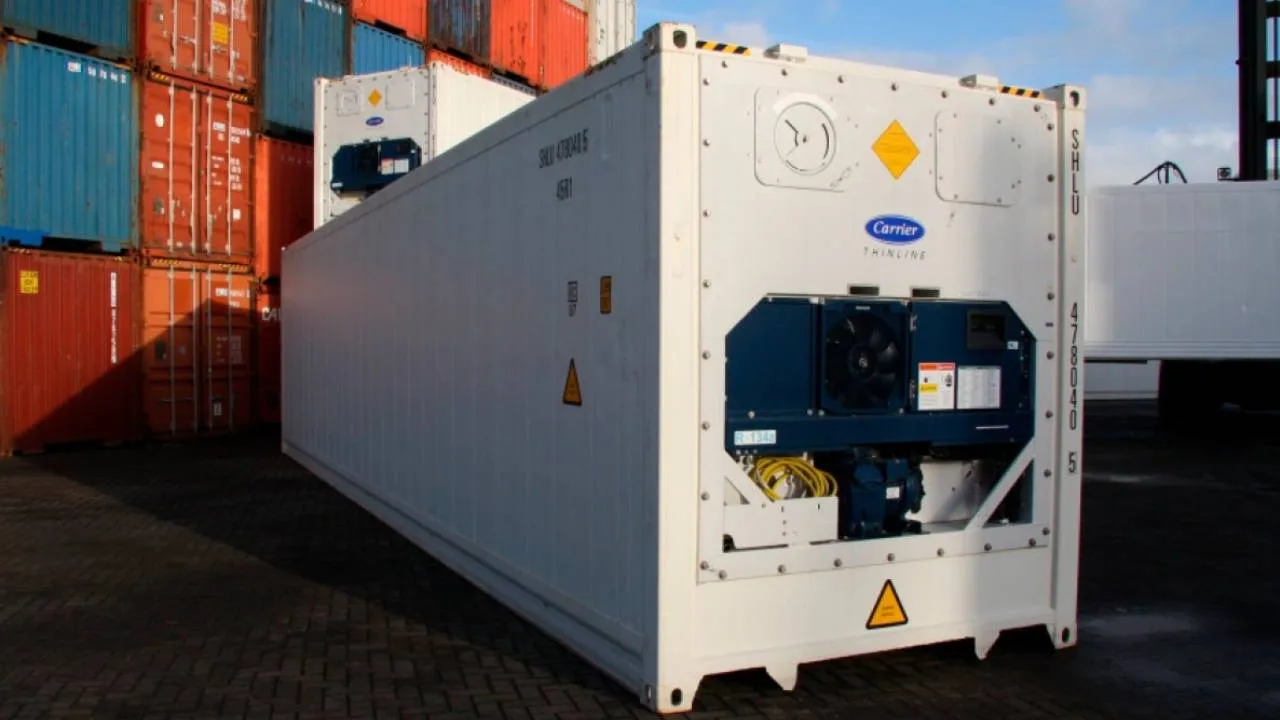
A reefer container is a shipping container with its own refrigeration unit, capable of keeping its interior in a range of roughly -30 °C to +30 °C (-22 to 86 °F) throughout the journey or for as long as the storage lasts. It is used to move and store perishable cargo: fresh fruit, flowers, meat, fish, dairy, frozen goods, medicines and vaccines. It comes in 20ft, 40ft and 40ft High Cube, and there is a deep-freeze version that goes down to -60 °C (-76 °F).
What is a reefer container
Unlike a dry shipping container, a reefer has walls, roof and floor insulated with high-density polyurethane and a refrigeration machine built into one end. The unit does not make cold from scratch: it extracts heat from the interior and holds the set-point temperature, so the cargo must go in already pre-cooled or pre-frozen.
The container is best understood in two parts: the insulated box, which preserves, and the refrigeration unit, which regulates. The most common machinery manufacturers in the world fleet are Carrier, Thermo King, Daikin and Starcool.
Types of reefer container
Standard refrigerated
The most common. It works above freezing, typically between 0 °C and +15 °C (32 to 59 °F), and is intended for fresh produce that must stay alive: fruit, vegetables, cut flowers, dairy, eggs, chilled meat and fish, and much of the pharmaceutical cargo, which travels between +2 °C and +8 °C (36 to 46 °F).
Frozen
The same unit, operating between -18 °C and -25 °C (0 to -13 °F). This is the range for frozen meat and poultry, fish and seafood, fruit pulp, par-fried potatoes and ice cream. Here the goal is no longer to preserve a product that respires, but to stop microbial activity completely.
Deep freeze (super freezer)
These are special units, with cascade refrigeration systems, that work at -60 °C (-76 °F) and in some models go down to -70 °C (-94 °F). When people talk about super-freezer containers they always mean very low negative values: there is no preservation container that operates at extreme positive temperatures.
Their classic use is sashimi-grade tuna bound for Japan, which must be kept below -60 °C to preserve color, texture and flavor. They are also used for swordfish, sea urchin and certain deep-frozen pharmaceutical and biological products.
Controlled and modified atmosphere
Controlled atmosphere actively regulates the oxygen and carbon dioxide levels inside the container to slow the fruit's respiration and delay ripening. It is the technology that lets Colombian bananas reach distant destinations: they travel at around 13.3 °C (56 °F) with about 3% oxygen and 4 to 5% carbon dioxide.
Modified atmosphere achieves a similar effect passively, with plastic bags or liners that alter the gas mix around the product. It is widely used with Hass avocados, together with ethylene filters that absorb the gas the fruit emits as it ripens.
Ventilated containers
Worth clarifying, because they are often confused with reefers: ventilated containers have no refrigeration machine, only vents that allow air exchange. They are used for cargo that is sensitive to humidity and condensation but needs no cold, such as green coffee, which is normally exported in a dry or ventilated container with liners and humidity control, not in a reefer.
Dimensions and capacities
The insulation and the machine take up interior space compared with a dry container of the same external size. These are the reference figures:
| Type | Internal length | Internal width | Internal height | Approx. volume |
|---|---|---|---|---|
| 20ft reefer | 5.44 m (17' 10") | 2.29 m (7' 6") | 2.26 m (7' 5") | 28 m³ (990 cu ft) |
| 40ft reefer | 11.58 m (38') | 2.29 m (7' 6") | 2.25 m (7' 5") | 59 m³ (2,080 cu ft) |
| 40ft High Cube reefer | 11.58 m (38') | 2.29 m (7' 6") | 2.50 m (8' 2") | 66 m³ (2,330 cu ft) |
In pallets, a 20ft container takes around 10 standard pallets and a 40ft roughly twice as many. Exact dimensions and maximum weight vary by manufacturer and model, even between units of the same external size, so it pays to ask for the data sheet of the specific unit you are going to use. You can browse available units in our online shop.
Temperatures by type of goods
Every product has its range. Using the wrong one causes chilling injury in some cases and accelerated ripening or bacterial growth in others.
| Goods | Transport temperature |
|---|---|
| Green bananas | 13.3 to 13.9 °C (56 to 57 °F) |
| Green Hass avocado | 5 to 7 °C (41 to 45 °F) |
| Mango | 10 to 13 °C (50 to 55 °F) |
| Orange and mandarin | 5 to 7 °C (41 to 45 °F) |
| Lemon and lime | 10 to 13 °C (50 to 55 °F) |
| Table grapes | -0.5 to 0 °C (31 to 32 °F) |
| Strawberries and berries | 0 to 1 °C (32 to 34 °F) |
| Cut flowers | 1 to 2 °C (34 to 36 °F) |
| Dairy | 0 to 4 °C (32 to 39 °F) |
| Fresh meat and fish | 0 to 2 °C (32 to 36 °F) |
| Vaccines and biologicals | 2 to 8 °C (36 to 46 °F) |
| Frozen meat and poultry | -18 °C (0 °F) or lower |
| Frozen fish and seafood | -18 to -25 °C (0 to -13 °F) |
| Ice cream | -25 to -18 °C (-13 to 0 °F) |
| Sashimi-grade tuna | -60 °C (-76 °F) |
The product-by-product detail is in our guides to
Parts of a reefer container
Outside, at the front end, sit the compressor, the condenser, the evaporator, the control box with the temperature panel, the fresh-air vent and the power socket. Inside, what matters is the T-bar floor, whose channels let cold air pass under the cargo, the baffle plate that distributes it, the condensate drains and the red load line, which marks the maximum height the cargo can be stacked to without blocking the return air.
The unit runs on three-phase power at 380 to 460 V and 50/60 Hz, and works with R-134a or R-404A refrigerants depending on the manufacturer. The set point is the target temperature programmed on the panel; the controller holds it within a tolerance of roughly ±2 °C on the supply or return air. If you want to understand the whole cycle, we explain it in
How a reefer is loaded
Stowage shapes the result as much as the machine does. The heaviest weight goes at the bottom and towards the back, light cargo on top, and the red line is never exceeded: if the return air is blocked, the unit reads a false temperature and the product at the back warms up.
Frozen cargo is stowed as a tight block, because cold is kept better with the mass together. Fresh cargo, by contrast, needs ventilation channels between boxes so the air can circulate and remove the fruit's heat of respiration. And in no case should the T-bar floor channels be blocked.
What to check before renting a reefer
- Valid PTI. The pre-trip inspection certifies that the machine responds across its full range. Ask for it in writing.
- The unit's real range. Not every machine holds -25 °C with a full load and a high ambient temperature. Confirm the operating range, not just the nominal one.
- Condition of the insulation and the T-bar floor. Dents in panels, crushed channels or badly done patches ruin air distribution.
- Door gaskets. A worn seal is the most frequent cause of excessive consumption and hot spots.
- Logging and monitoring. Data logger, download of temperature curves and, where applicable, real-time remote monitoring.
- Power supply. Check that the site has a suitable three-phase supply, or plan a genset generator for road transit.
- Cleanliness and odors. A container that carried fish is no good for flowers or pharmaceutical product.
- Health requirements. Depending on the cargo, you will be required to meet the food safety or agricultural export standards of your market; in Colombia, that means INVIMA for processed food or ICA for agricultural export product.
The rental or purchase cost depends on the size, the temperature range, the time of use, the delivery city and whether you need a genset or satellite monitoring. See our refrigerated containers or contact us to review a specific case.
Frequently asked questions
What is the minimum temperature of a reefer container?
A standard reefer goes down to roughly -30 °C (-22 °F). For lower values you need a deep-freeze or super-freezer container, which operates at -60 °C (-76 °F) and in some models down to -70 °C (-94 °F).
Does a reefer container freeze the cargo?
No. It is designed to maintain the temperature, not to lower it. The goods must reach the container already pre-cooled or pre-frozen; if they go in warm, the unit can take days to stabilize them and the product deteriorates in the attempt.
What is the difference between a reefer and a ventilated container?
A reefer has a refrigeration machine and actively controls the temperature. A ventilated container only has air-exchange vents and is used for humidity-sensitive cargo, such as green coffee, that does not require cold.
What size of reefer do I need?
It depends on volume and weight. As a reference, a 20ft holds around 28 m³ (990 cu ft) and a 40ft High Cube around 66 m³ (2,330 cu ft). If the cargo is bulky and light, the High Cube is the better choice; if it is dense, the 20ft is usually enough because weight sets the limit.
Can a reefer be used as a fixed cold room?
Yes. Connected to a three-phase supply it works as a modular cold room and is a fast alternative to building a cold room on site. See the options in refrigerated containers.