Intermodal vs. Multimodal Transport: What Is the Difference?

The difference between intermodal and multimodal transport is not in the trucks or the ships: it is in the contract and in who is liable to the cargo owner. In intermodal transport the goods move on two or more modes under several contracts, one per leg, and each carrier is liable only for its own. In multimodal transport the same goods move on the same modes, but under a single contract and with a single party liable end to end: the Multimodal Transport Operator (MTO), which issues a single document, the Multimodal Transport Document (MTD).
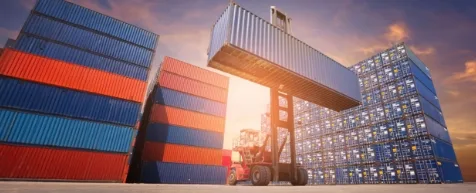
Everything else, the container, the terminals, the transshipments, the crane that lifts the box from the ship to the truck, can be identical. What changes is the legal structure of the operation, and that decides who you claim against the day the cargo arrives wet, incomplete or late.
What is intermodal transport
Intermodal transport is the movement of goods in the same loading unit, usually a shipping container, combining two or more modes of transport without handling the goods at transshipment. The box goes from the ship to the truck or the train, but the cargo inside is never touched.
The contractual key is that the cargo owner (or its agent) contracts each leg separately: an ocean freight with the shipping line, road transport with a trucking company, storage with a depot. One document is issued per leg: a bill of lading for the ocean leg, a consignment note or cargo manifest for the road leg, an air waybill for the air leg.
That gives control: the cargo owner negotiates each segment with whoever serves it best and can change provider on one leg without touching the others. It also creates work: schedules, terminal windows and equipment must be coordinated, and the gaps between one contract and the next are the owner's to manage.
What is multimodal transport
Multimodal transport is defined, under Decision 331 of 1993 of the Andean Community (amended by Decision 393 of 1996) and along the same lines as the UN Convention on International Multimodal Transport, as the carriage of goods by at least two different modes of transport under a single multimodal transport contract, from the place where the MTO takes the goods into its custody to the place designated for delivery.
The MTO is not an intermediary: it contracts as a carrier and assumes liability for the whole performance. Its liability starts when it issues the document and takes the cargo into custody, and ends with delivery at destination; it covers loss, damage and delay in delivery.
In Colombia, Decree 149 of 1999 regulates the Register of Multimodal Transport Operators, kept by the Ministry of Transport, for both domestic and international operations. If you are going to contract multimodal transport there, checking that register is the first filter. Other countries keep equivalent registers or licensing schemes for MTOs.
Comparison table: intermodal vs. multimodal
| Criterion | Intermodal | Multimodal |
|---|---|---|
| Number of contracts | One per leg | One, from origin to destination |
| Document issued | One document per mode: bill of lading, consignment note, air waybill | Multimodal Transport Document (MTD) |
| Who is liable to the cargo owner | Each carrier, only for its leg | The MTO, for the whole operation |
| Points of contact | Several providers | One |
| Damage claims | You must prove on which leg the damage occurred | You claim against the MTO regardless of the leg |
| Applicable legal framework | The rules of each mode | Multimodal transport rules (in the Andean region, Decisions 331 and 393; in Colombia, Decree 149 of 1999) |
| Control over the rate | Negotiated leg by leg | Integrated rate set by the MTO |
| Administrative burden | High: multiple coordination and documents | Low: one contract, one invoice, one counterpart |
A quick reading: intermodal gives you control; multimodal gives you one liable party. Which one suits you depends on what hurts more, the rate or the risk of having no one to claim against.
What this looks like on a real route: Colombia
Colombia has two coastlines and a mountainous interior, so almost no import ends at the port: it continues overland. These are everyday scenarios.
Shanghai–Buenaventura–Bogotá. The ocean leg arrives at Buenaventura and the container climbs the Buga–Buenaventura road up to the Bogotá plateau. If the importer contracts the freight with the shipping line and separately arranges the truck, it is intermodal. If an MTO quotes door to door and issues an MTD, it is multimodal: the delay at the port and the damage on the road are claimed against the same party.
Cartagena as gateway and transshipment hub. According to the port traffic bulletin of Colombia's Superintendency of Transport, in 2025 Colombian ports handled 6.2 million TEU, 17.2% more than in 2024. The port zone of Cartagena concentrated 4.04 million TEU (65% of the national total), followed by Buenaventura with 1.7 million (27.3%) and Santa Marta with 127,900 TEU (2.1%). That concentration explains why a good share of the country's multimodal operations start on the Caribbean coast.
Rail plus truck. The La Dorada–Chiriguaná rail corridor, 526 kilometers (327 miles) long, moved 1,030,789 tons between January and November 2025, according to the National Infrastructure Agency (ANI), about 350% more than in all of 2024, with general cargo and containers. It is the textbook case of intermodalism: the train covers the long haul and the truck does the first and last mile.
When each one makes sense
Intermodal usually pays off when:
- You handle stable volumes and repeated routes, and already have rates negotiated per leg.
- You have your own equipment or trusted carriers for the road leg.
- You want to see and control the cost of each segment, not a global figure.
Multimodal usually pays off when:
- You need door-to-door delivery and have no team to coordinate four providers.
- The cargo is sensitive and you want a single liable party if something happens.
- It is a new operation, a destination you do not know or a customer that demands a firm delivery date.
There is no universal answer, and many companies use both structures depending on the route. What is a mistake is signing in the belief that you contracted multimodal when there are actually three separate contracts: that is discovered on the day of the loss.
Frequently asked questions
Are intermodal and multimodal synonyms?
No. Both combine several modes of transport with the same loading unit, but intermodal uses several contracts and several liable parties, and multimodal one of each. In commercial conversation they are often used as synonyms; in a claim, they are not.
Who is liable if the goods arrive damaged?
In multimodal, the MTO is liable: it takes on the whole operation as carrier from the moment it takes the cargo into custody until delivery. In intermodal, the carrier of the leg where the damage occurred is liable, which forces you to determine where it happened, and that is where time and money are lost.
How do I check that an MTO is registered?
In Colombia, the Register of Multimodal Transport Operators is kept by the Ministry of Transport under Decree 149 of 1999. Ask for the registration number and confirm it before signing. An operator that issues multimodal documents without being registered leaves you exposed.
What document should I demand in a multimodal operation?
The Multimodal Transport Document (MTD), identified as such and with the details required by the applicable rules. That document is the proof that the operator took the goods into its custody and is liable for them until the agreed destination.
Do I need a container for intermodal transport?
It is not mandatory, but it is the usual and most efficient option. The standardized loading unit is what allows the cargo to pass from ship to train or truck without opening or handling the goods, which is precisely the saving that makes this mode viable.
 Need a container for your intermodal operation? See our new and used shipping containers.