Everything You Need to Know About Industrial Refrigeration Systems
An industrial refrigeration system maintains a specific temperature and humidity for preserving and processing certain products, many of which are part of our everyday life, such as food and plastics. Below we look at the different types of industrial refrigeration you can find.
Classification by cooling agent
Before discussing the different types, we need to look at how these systems are classified according to the fluid they use:
- Direct and indirect systems: this type combines evaporation, compression, condensation and expansion in a single stage, extracting heat from inside the cold room and expelling it outside.
- Open and closed systems: these are defined by the degree of contact between the fluid and the medium. In open systems the refrigerant comes into direct contact with the medium; in a closed system, the cooling agent travels through other channels, such as tubes, and does not come into direct contact.
- Air or water systems, where those elements are used as the cooling agent.
Types of industrial refrigeration
- Air cooling system: one of the oldest and cheapest systems there is, since it only uses air to extract heat and increase the contact area with the air in order to dissipate it. It is in turn divided into two types:
- Passive air cooling: called passive because it requires no work or effort to operate, and it can dissipate large amounts of heat in a short time.
- Active air cooling: this type needs a component to increase the airflow required for cooling. Fans or turbines are generally used for the task.
- Liquid cooling system: a more complex system than the previous one because, compared with air, water has a higher heat capacity and better thermal conductivity, and is therefore more efficient at transferring heat.
- Thermoelectric cooling system: this system relies on the principle that bringing two metals or semiconductors into contact generates an electrical difference that reduces heat considerably. It works both for cooling and for the opposite effect.
- Evaporative coolers: a system of water-soaked pads that are cooled by a constant airflow; the pads absorb heat from the water and, through evaporation, lower the temperature of the surroundings. This system can condition both small spaces and industrial areas and is well suited to maintaining optimal humidity levels.
- Cryogenic cooling system: uses products that lower the temperature of the environment considerably. The most common are dry ice and liquid nitrogen. It is suitable for environments that require very low temperatures.
Refrigeration systems in shipping containers
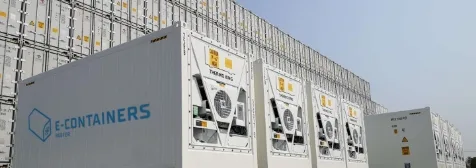
In the case of refrigerated containers, or reefers, the refrigeration unit is mounted externally so it does not take up internal space. It runs on electricity and therefore needs a power connection on the ship, the truck or at the terminal. These containers are refrigeration units for transporting sensitive industrial cargo such as food, pharmaceuticals and chemicals.
To know which type of system suits you, you need to understand the environment, its needs and what kind of products you need to refrigerate. Now that you know how the different systems are classified, you can identify which one fits each case.
 Need refrigeration you can move? See our 20ft and 40ft reefer containers.