What Temperature Should a Freezing System Run At?

A freezing system should operate between -18 °C and -23 °C (0 °F and -9 °F). That is the standard working range for frozen food and the point at which microbial and enzymatic activity practically stops. From there, the exact temperature depends on the product: ice cream and fish call for lower values, around -25 °C (-13 °F), and sashimi-grade tuna demands -60 °C (-76 °F).
In Colombia, moreover, Resolution 2674 of 2013 from the Ministry of Health sets -18 °C (0 °F) or lower as the freezing condition for food, so that value is not just good practice: it is the enforceable minimum. Food safety regulations in the United States and Europe use the same -18 °C benchmark.
Freezing temperature by product type
This is the reference by category. The ranges refer to product temperature, not to the supply-air reading, which is always somewhat lower.
| Category | Storage temperature | Note |
|---|---|---|
| Meat (beef, pork) | -18 to -20 °C (0 to -4 °F) | Below -18 °C fat oxidation slows down |
| Poultry | -18 °C (0 °F) or lower | Prone to freezer burn if the packaging is not airtight |
| Fish and seafood | -18 to -25 °C (0 to -13 °F) | Fatty fish degrade faster; the low end is preferred |
| Sashimi-grade tuna | -60 °C (-76 °F) | Requires an ultra-low-temperature or super freezer container |
| Frozen dairy (butter, cheese) | -18 °C (0 °F) | Fresh dairy is refrigerated at 0 to 4 °C (32 to 39 °F), not frozen |
| Ice cream and frozen desserts | -25 to -18 °C (-13 to 0 °F) | Texture suffers with any partial thaw cycle |
| Frozen fruit and vegetables (IQF) | -18 to -20 °C (0 to -4 °F) | Includes fruit pulp and par-fried potatoes |
| Frozen pharmaceuticals | -25 to -15 °C (-13 to 5 °F) | The condition is set by the manufacturer's data sheet |
| Ultra-low-temperature biologics | -60 to -70 °C (-76 to -94 °F) | Ultra-cold chain, with cascade refrigeration equipment |
| Refrigerated vaccines and biologics | +2 to +8 °C (36 to 46 °F) | Must never be frozen |
If your cargo is chilled rather than frozen, the range is different and we cover it in
Why -18 °C is the standard
The value is not arbitrary. At -18 °C (0 °F) most of the free water in the food is crystallized, bacteria do not multiply and enzymatic reactions become so slow that the product keeps its characteristics for months. It is the internationally accepted threshold for a food to be declared frozen.
Going lower does not always pay off. Between -18 °C and -25 °C (0 °F and -13 °F) you gain shelf life and stability, but also power consumption. Below -25 °C the cost of equipment and energy rises sharply, and it is only justified for products such as export tuna, certain seafood and ultra-cold biologics.
Applicable regulations
For food in Colombia, the main reference is Resolution 2674 of 2013, which sets the sanitary requirements for manufacturing, processing, storing, selling and importing food and is enforced by INVIMA. On temperature it sets two conditions worth keeping in mind:
- Freezing: -18 °C (0 °F) or lower.
- Refrigeration: no higher than 4 °C (39 °F), with a tolerance of ±2 °C.
The same rule requires that storage takes into account the temperature, humidity and air circulation each food needs, that those variables are controlled and recorded, and that measuring devices are inspected at regular intervals to verify their accuracy. In practice, that means calibrated thermometers and paper or electronic logs available for an inspection visit. Similar requirements apply under the FDA in the United States and under EU food hygiene rules.
When the product is agricultural or livestock bound for export, the phytosanitary and animal health authority of the origin country also steps in, and some markets require quarantine cold treatments with specific temperatures and durations.
What happens if the cold chain breaks
A break in the cold chain is irreversible: even if the product goes back to -18 °C, it does not recover its previous state. These are the usual effects.
- Recrystallization. As the temperature rises, ice crystals partially melt and re-form larger, breaking cell walls. The result is loss of texture and drip loss on thawing.
- Freezer burn. The visible frost inside the package is water that left the food. It leaves dry, discolored, flavorless areas.
- Microbiological risk. If the product enters the range where bacteria reactivate, the microbial load grows, and refreezing does not eliminate it, only stops it.
- Nutritional and sensory loss. Color changes, off odors and vitamin degradation.
- Rejection at destination. In export, a temperature curve with documented deviations is reason enough for the buyer to reject the container.
The easiest sign to spot in the warehouse is frost or ice crystals formed inside the package: they indicate at least one partial thaw cycle.
How temperature is monitored
A freezing system without records is a system without evidence. The usual control layers are four:
- Equipment controller. Shows the set point and the supply and return air temperatures. It is the operating data, not the evidence.
- Independent probes and data loggers. Placed at critical points, usually the one farthest from the evaporator and the area near the doors. They record at fixed intervals and let you download the full curve of the trip or the storage period.
- Remote monitoring. Telematics with GPS and deviation alarms, which warn before the cargo is lost. It is the standard for high-value cargo and long transits.
- Manual verification. Calibrated product thermometer, with temperature readings at loading and unloading, signed on a log sheet.
Periodic calibration of all these instruments is an explicit regulatory requirement, not an optional extra.
Factors that affect the actual temperature
The set point is an intention; the actual product temperature depends on several factors.
- Stowage and air circulation. Frozen cargo is stowed compactly and never above the maximum load line, so the air can return freely. Blocking the return makes the unit read a false temperature.
- Door openings. Every opening lets in warm, humid air. For frequent picking operations, strip curtains or an antechamber are advisable.
- Defrost cycles. They are necessary, but poorly scheduled they cause repeated temperature rises in the cargo near the evaporator.
- Humidity. Too much creates ice on the evaporator and loses efficiency; too little dehydrates the product.
- Product loaded warm. Storage equipment is not designed to freeze. If the goods do not arrive pre-frozen, the temperature of the whole load rises for days.
Refrigerated containers as a freezing system
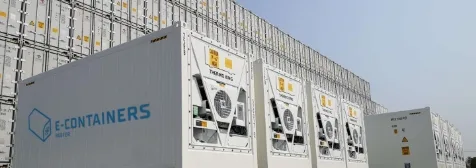
A refrigerated container covers the -18 °C to -25 °C (0 °F to -13 °F) range with no construction work and can be installed at a plant, on a farm or at a port. It is the fastest way to add freezing capacity in high season or to back up an existing cold room. For ultra-low temperatures of -60 °C (-76 °F) a specific super freezer unit is required; we explain it in
The cost depends on the temperature range, the size, the length of use and the delivery location. Tell us about your case and we will quote the right unit.
Frequently asked questions
What is the minimum temperature of a freezer room?
Commercial freezing equipment usually goes down to -25 °C (-13 °F), and standard reefer containers to around -30 °C (-22 °F). Below that, cascade refrigeration systems are needed, which reach -60 °C or -70 °C (-76 °F or -94 °F).
Why -18 °C and not -15 °C?
At -18 °C (0 °F) the frozen water fraction is enough to stop microbial growth and slow enzymatic reactions. At -15 °C (5 °F) those reactions keep advancing slowly and shelf life is noticeably shorter. -18 °C is also the value food regulations require.
Can a product that thawed be refrozen?
It is not advisable. Refreezing does not eliminate the microbial load that grew during thawing, and it destroys texture through recrystallization. For food intended for sale, the practice is to reject the batch.
What temperature do pharmaceuticals require?
It depends on the product. Refrigerated ones go between +2 °C and +8 °C (36 °F and 46 °F) and must not be frozen; frozen ones are handled between -25 °C and -15 °C (-13 °F and 5 °F), and some biologics require ultra-cold storage at -60 °C to -70 °C (-76 °F to -94 °F). The binding condition is always the one the manufacturer states in the data sheet.
How often should temperature be recorded?
Regulations do not set a single interval, but they require control, records and regular inspection of the devices. In practice, data loggers record every 5 to 15 minutes and are complemented with a documented manual check at loading and unloading.
 Looking for refrigerated storage? See how our reefer containers can cover your freezing needs.